AI Marketing for Tourism: How Smart Destination Brands Win in 2026
AI marketing for tourism is no longer about automation hype or experimental tools. It is about building digital authority in a landscape where AI systems influence discovery, comparison, and conversion before a traveler ever visits your website.
Search engines summarize answers. AI platforms recommend operators. Predictive models adjust paid media in real time. Review sentiment is interpreted instantly. Competitive destinations are filtered through intelligent systems.
Tourism brands that integrate AI into SEO, content strategy, paid media, audience targeting, and user experience will dominate visibility across search engines, AI systems, and destination-level competition.
This is not about replacing marketing. It is about upgrading it.
Why AI Marketing Matters for Tourism Brands in 2026
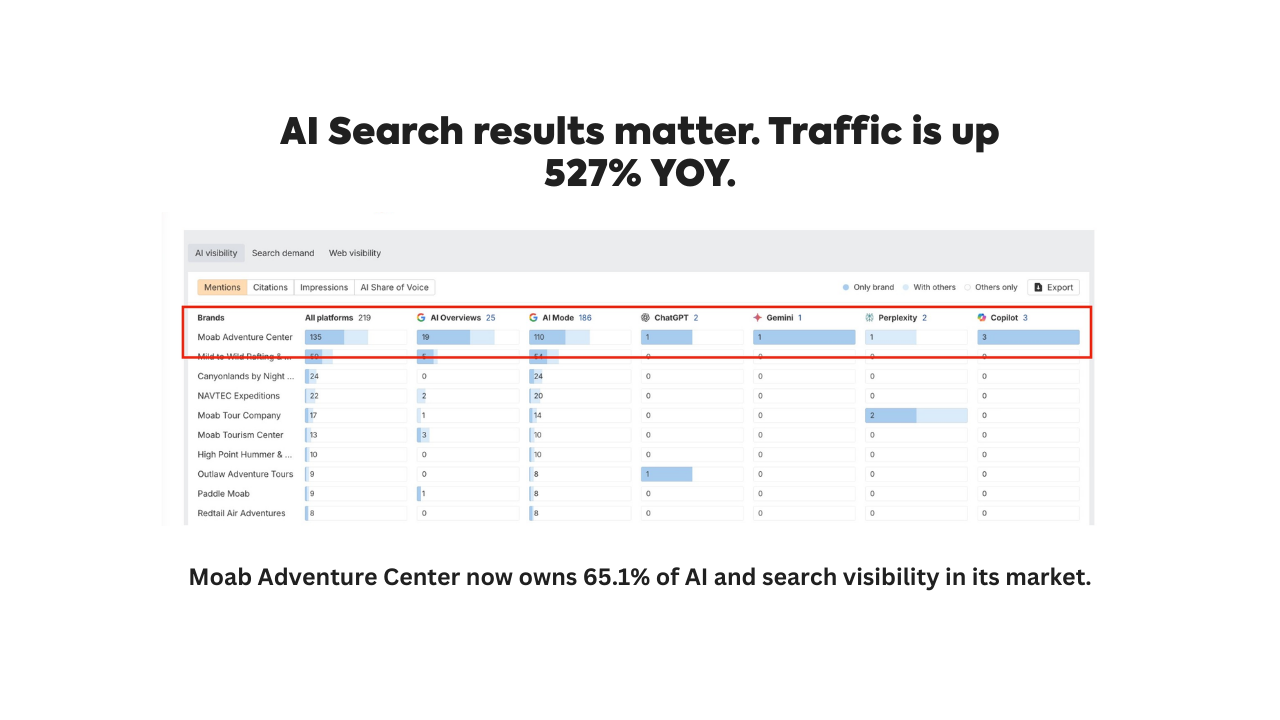
Trip planning behavior has shifted.
Travelers now:
- Ask AI tools for destination ideas
- Request comparisons between tour operators
- Ask whether pricing is fair
- Generate sample itineraries
- Summarize reviews before clicking
AI has become a discovery engine.
Instead of typing a query and clicking multiple links, users receive summarized recommendations. If your brand is not structured clearly and recognized as authoritative, you may not appear in that recommendation layer. This is especially critical in competitive destinations where dozens of similar experiences exist. Authority determines inclusion.
AI-first search journeys compress research time. Visibility must be earned earlier and reinforced structurally.
If your marketing efforts are fragmented across channels without an integrated AI strategy, you risk invisibility in the very systems shaping demand.
A structured AI visibility assessment can reveal whether your brand is appearing in AI-driven discovery environments.
This is why working with a
tourism-specialized SEO agency that understands competitive destinations and booking behavior is no longer optional, it’s infrastructure.
What AI Marketing for Tourism Actually Means
AI marketing does not mean installing a chatbot and calling it innovation.
AI marketing for tourism includes:
- Predictive audience modeling
- AI-powered content analysis
- SEO and AI search optimization
- Paid media automation
- Experience personalization
- Behavioral data integration
- Conversion modeling
It functions as strategic infrastructure, not a shortcut.
AI enhances decision-making across the entire funnel. It informs which content to create, which audiences to target, which landing experiences convert best, and which signals strengthen authority.
When integrated correctly, AI connects visibility and revenue.
When used tactically without structure, it creates noise.
How AI Enhances SEO for Tourism Brands
SEO remains foundational. AI amplifies its impact.
AI and Search Visibility
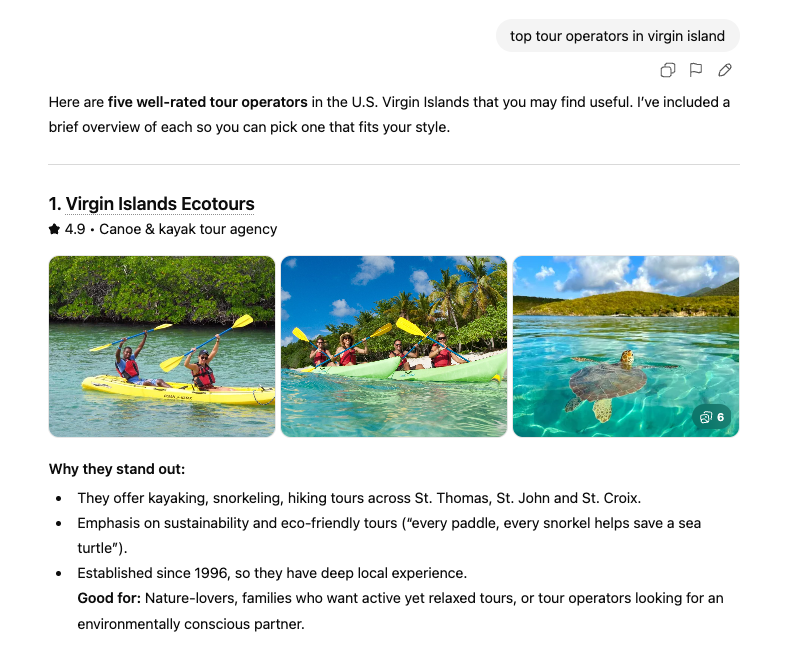
AI Overviews, generative answers, and conversational search systems rely on:
- Structured content
- Clear headings
- Direct answers
- Entity-based ranking signals
- Schema markup
AI SEO for tourism brands strengthens both traditional rankings and citation likelihood inside AI summaries.
If your content is shallow or technically weak, AI systems struggle to interpret it confidently.
Clear structure increases discoverability.
AI and Content Strategy
AI-powered analysis enables:
- Intent-based content creation
- Question clustering around destination topics
- Topic authority mapping
- Gap analysis against competitors
Instead of guessing what to publish, tourism brands can identify which high-value questions they do not yet own.
Authority is built through structured ecosystems, not isolated posts.
AI in travel marketing strengthens editorial precision. It does not replace expertise. Human insight defines the strategy. AI accelerates execution and analysis.
AI and Local Authority
Tourism is location-dependent.
AI can analyze:
- Review sentiment patterns
- Common guest concerns
- Recurring praise themes
- Location-specific search signals
This informs messaging, FAQ content, and trust-building assets
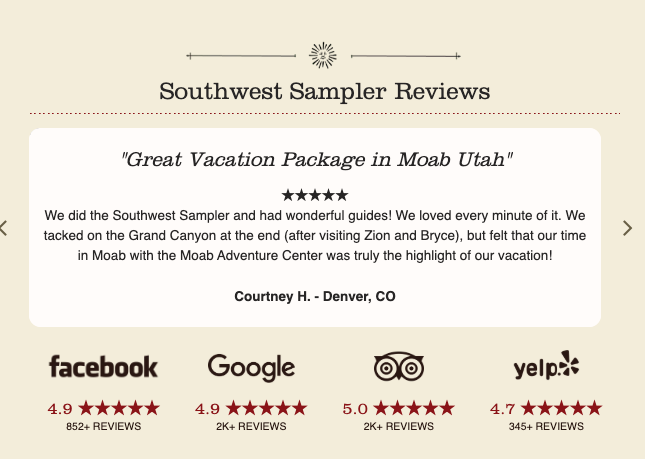
Local SEO signals, structured review data, and tourism board citations increase credibility in both search and AI-driven recommendations.
AI and Paid Media: Precision Targeting and Budget Optimization
AI-powered tourism campaigns refine targeting through:
- Predictive segmentation
- Behavioral modeling
- Conversion probability scoring
- Cross-channel attribution analysis
Rather than broad targeting, AI systems identify users most likely to book and allocate budget dynamically.
Paid media becomes more efficient when organic authority is strong. AI bridges data across channels, improving budget allocation and messaging relevance.
This reduces wasted spend and increases booking efficiency.
AI and User Experience: Turning Visibility Into Revenue
Visibility alone does not generate growth.
AI-driven analytics reveal:
- Booking flow friction
- Drop-off points
- Device-based behavior differences
- Abandoned cart patterns
Personalized landing experiences can adjust messaging based on source, location, or behavioral signals.
Conversion data feedback loops refine performance continuously.
When AI enhances user experience, marketing does not simply attract traffic. It converts it more effectively.
How AI Marketing Reduces Dependence on OTAs
OTA platforms provide visibility but extract margin.
AI-enhanced SEO captures early discovery in the Dreaming stage. Lifecycle automation nurtures Planning. Optimized booking architecture strengthens conversion.
As direct visibility increases, OTA dependency decreases.
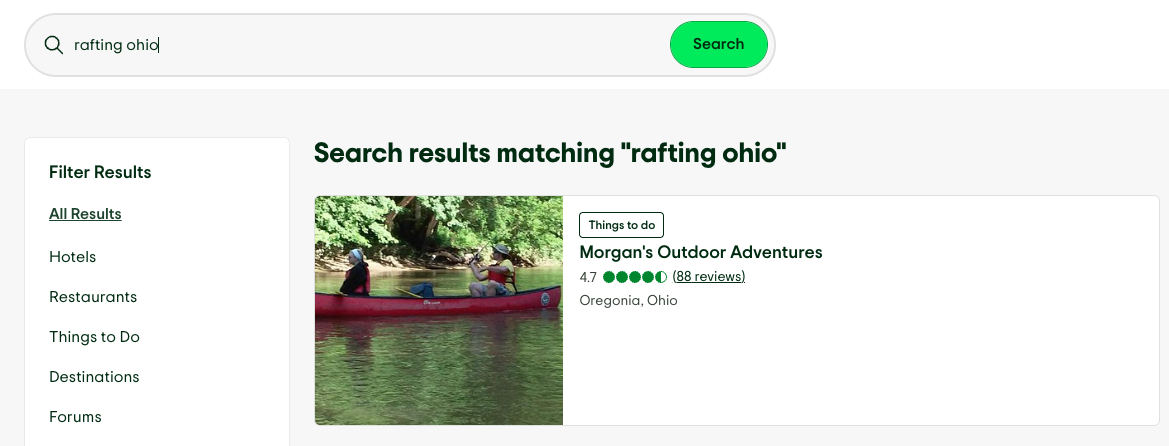
AI marketing for destinations supports brand authority rather than commission dependence.
The Growth Engine framework reinforces this connection:
- Dreaming strengthened through AI-enhanced SEO
- Planning improved through predictive nurture sequences
- Booking optimized via friction analysis
- Sharing amplified through sentiment-driven review systems
Authority compounds when stages connect.
Keys to a Successful AI Strategy for Tourism Brands
1. Define Revenue-Driven Objectives
AI must support measurable outcomes tied to bookings, revenue, and lifetime value.
2. Centralize Clean, Actionable Data
Fragmented data weakens AI insights. Consolidated analytics strengthen predictive accuracy.
3. Build Topical Authority, Not Just Traffic
Authority improves AI citation and organic ranking. Random content does not.
4. Prioritize Trust, Privacy, and Brand Integrity
Transparent policies and strong review sentiment reinforce credibility signals that AI systems interpret.
5. Integrate AI Across the Entire Funnel
Transparent policies and strong review sentiment reinforce credibility signals that AI systems interpret.
5. Integrate AI Across the Entire Funnel
Disconnected experimentation limits impact. Integration across SEO, paid media, content, and UX produces compounding growth.
6. Measure Visibility and Conversion Together
Evaluate AI citations, organic traffic, assisted conversions, and booking revenue holistically.
AI marketing becomes powerful when visibility metrics connect to revenue outcomes.
The Future of AI Marketing in Tourism
Search is shifting toward entity-based recognition rather than isolated keywords.
AI systems summarize content, recommend authoritative brands, and reduce browsing steps.
Structured data dominance will increase. Content summarization will replace multi-tab research. Authority-driven brand selection will become standard.
Tourism brands that invest in structured content, AI visibility monitoring, and integrated funnel strategy will gain durable advantages.
AI marketing for tourism is not replacing traditional marketing. It is reshaping how discovery begins.
How ResmarkWeb Builds AI-Powered Digital Authority
ResmarkWeb specializes in building digital authority for tourism brands in competitive destinations. By connecting SEO, content strategy, paid media, and user experience optimization, the agency strengthens both visibility and conversion outcomes. Its strategic approach is rooted in data analysis and industry expertise.
ResmarkWeb functions as a strategic growth partner for tourism businesses seeking predictable booking expansion. The agency develops cohesive marketing frameworks that integrate SEO, paid acquisition, analytics, and conversion optimization.
Its mission is to help tour operators strengthen market presence and drive sustainable direct revenue growth.
Through integrated AI strategy, ResmarkWeb provides:
- AI search monitoring
- Authority mapping across destinations
- Competitive landscape analysis
- Structured content frameworks
- Conversion architecture optimization
- Growth Engine alignment
The objective is not automation for its own sake. It is measurable, sustainable direct revenue growth.
Ready to Build Your AI Marketing Advantage?
If your brand is hearing about AI everywhere but lacks a cohesive strategy, now is the time to act.
An AI Marketing Strategy Audit can uncover:
- Visibility gaps in AI search environments
- Content authority weaknesses
- Paid media inefficiencies
- Conversion friction points
- Structural data issues
An AI Visibility Assessment reveals whether your brand appears in generative search recommendations.
A Tourism SEO and AI Consultation aligns AI marketing for tourism with measurable booking growth.
Authority is the competitive moat in 2026. AI amplifies whoever builds it correctly.
Frequently Asked Questions
What is AI marketing for tourism?
AI marketing for tourism integrates artificial intelligence into SEO, content strategy, paid media, analytics, and user experience to enhance visibility and increase direct bookings.
How does AI improve tourism marketing performance?
AI improves audience targeting, budget efficiency, content gap analysis, personalization, and conversion optimization through data-driven modeling.
Can AI marketing reduce OTA reliance?
Yes. By strengthening organic authority and improving direct booking systems, AI marketing can increase direct revenue and reduce commission dependency.
How does AI connect to SEO for tourism brands?
AI systems extract structured content and prioritize authoritative sources. Strong SEO foundations improve both ranking and AI-generated recommendation likelihood.
Is AI marketing only for large travel companies?
No. Scalable AI strategies apply to destination marketers, tour operators, and experience businesses of all sizes when implemented strategically.
Does AI replace traditional tourism marketing strategies?
No. AI enhances traditional marketing by improving precision, efficiency, and authority. It strengthens strategy rather than replacing it.
Travel & Tourism Marketing Blog