WildReality Safari | Case Study
"This is the vision and direction I've been wanting. It's finally becoming a reality."
WildReality Safari is a Tanzanian-owned safari company based in Dar es Salaam, offering tailor-made private journeys across the country's most iconic landscapes: the Serengeti and the Great Migration, the Ngorongoro Crater, Mount Kilimanjaro, and the beaches of Zanzibar. Founded by Tanzanian native and lifelong conservation advocate Allen Kimbelwa, the company is built on a 100% local team and a community-first philosophy, pairing genuine cultural connection with private, expertly guided travel for families, couples, solo travelers, and honeymooners alike.
The brand's reputation was already real and earned, backed by a 2025 Travelers' Choice Award, a feature on Dutch national television (RTL Z and RTL7), and guests from more than forty countries. But that standing was invisible online. The previous website was technically broken and structurally shallow, ranking for virtually nothing and hiding the depth of the company's actual offering behind a handful of pages. The goal of this engagement was clear: rebuild WildReality Safari on an SEO-driven foundation that could earn organic visibility, showcase the full range of tours, and turn the brand's offline credibility into direct inquiries.
Highlights
- A logical, search-ready site structure. The old site's chaotic URL scheme (two competing tour systems, author and category blog taxonomies, and deeply nested paths) was consolidated into a clean, flat hierarchy (/tours/…, /kilimanjaro/{route}, /destinations/…, /practical-information), with every legacy URL mapped through 301 redirects.
- The right keywords on the right pages. Every new URL is a descriptive, intent-aligned target, such as great-migration-safari, kilimanjaro/machame-route, family-safari-tanzania, and photography-safari, replacing internal marketing names like “serengeti-stars-island-dreams” with terms travelers actually search.
- A competitor gap that is structural, not brand. Specialist peers rank on page one at Domain Rating 42 to 50 with thousands of monthly organic visits, while WildReality started near zero (DR 4.6) despite a stronger real-world reputation. The gap was created by a broken foundation, not a weaker brand.
- UX built for visibility and dwell time.
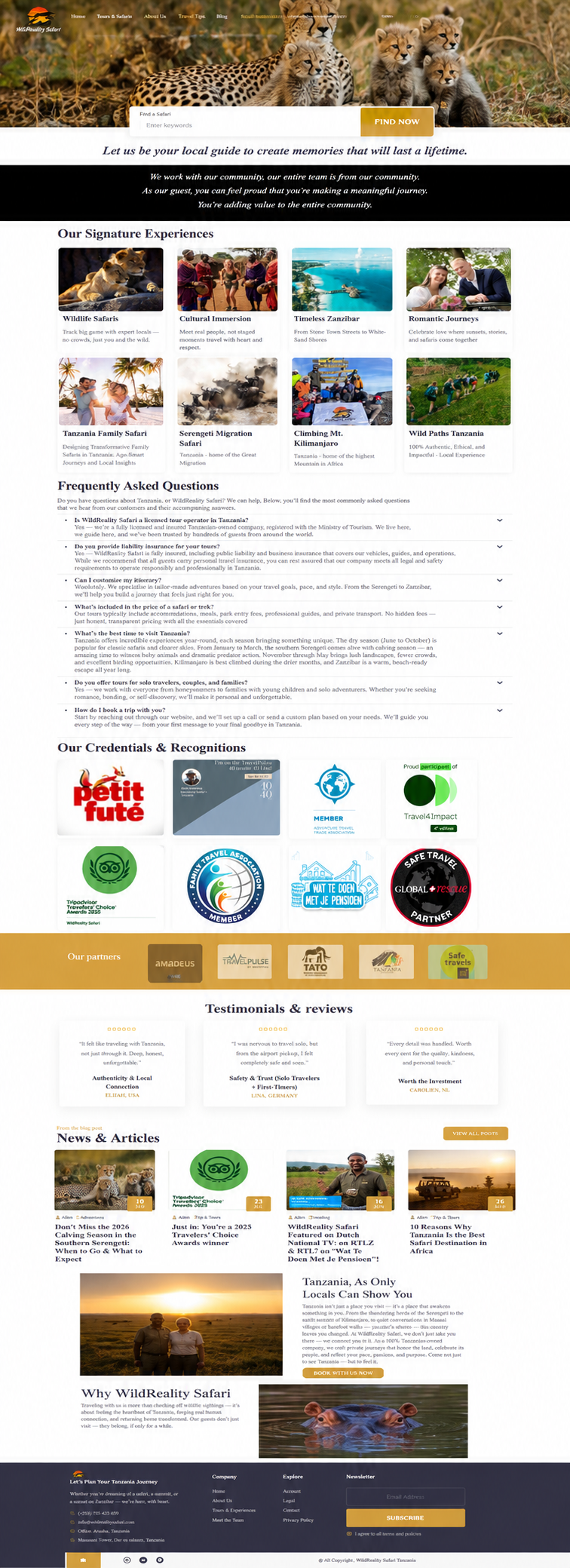
A thin, template-like site with only three tour entry points and an empty “partners” trust band became an immersive, proof-led experience with a structured, priced tour catalog, founder story, accreditations, and a guided planning journey.
The Opportunity
WildReality Safari had everything a growth engine needs except the foundation to run on: a Tanzanian-owned story, award-winning service, international press, and a deep catalog of tours. What it lacked was a website search engines and travelers could actually navigate. The old site left significant ground uncovered:
- A crawl surfaced 69 broken (404) pages and near-orphan pages reachable by a single internal link, signalling a fragmented, hard-to-crawl structure.
- 104 duplicate pages without canonical tags diluted relevance and split any authority the site could earn.
- 110 pages were missing an H1, along with meta descriptions, Open Graph, and Twitter tags, leaving pages unlabeled for both search and social.
- Two parallel tour systems and author/category blog taxonomies scattered the offering instead of organizing it.
A crawl surfaced 69 broken (404) pages and near-orphan pages reachable by a single internal link, signalling a fragmented, hard-to-crawl structure.
104 duplicate pages without canonical tags diluted relevance and split any authority the site could earn. 110 pages were missing an H1, along with meta descriptions, Open Graph, and Twitter tags, leaving pages unlabeled for both search and social.
Two parallel tour systems and author/category blog taxonomies scattered the offering instead of organizing it.
The Need
The previous site's limitations ran from the technical to the experiential. Structurally, it was a maze: legacy paths like /pages/list/tours/… and /pages/tours/… ran two competing tour systems in parallel, while blog content fractured across author and category taxonomies (/pages/Allen/posts, /pages/Adventures/category) that generated thin, overlapping pages. Health was worse still: 92 pages exceeded Googlebot's 2MB crawl limit, 105 rendered as slow pages, images and CSS were broken across the site, and none of it was captured in a sitemap. Experientially, the site undersold the brand. The main tours page exposed just three journeys as the entry point to a much larger catalog, trust sections sat empty (a “partners” band with no logos), pricing and tour detail were absent, and large stretches of dead white space flattened any sense of hierarchy or momentum. For a company with genuine credentials, the digital experience read as generic and incomplete.
The Plan
- Rebuild the information architecture around intent. We replaced the tangled legacy structure with a flat, logical hierarchy: /safaris-tours as the hub, individual /tours/{descriptive-slug} pages, /kilimanjaro/{route} for each trekking route, and /destinations/{place} for regions like Zanzibar. Every old URL was then 301-redirected to its new home. The result is a site both crawlers and travelers can navigate, with authority consolidated instead of scattered across duplicates.
- Map keywords to purpose-built pages. Rather than chase head terms owned by marketplaces, we targeted the winnable mid- and long-tail: route-level, experience-level, and practical-intent queries. Each page carries a descriptive, search-aligned URL and a unique H1, title, and meta description, closing the on-page gaps (110 missing H1s, absent metadata) that had kept the old site unlabeled and invisible in search.
- Fix the technical foundation. We resolved the issues suppressing crawlability and rankings: eliminating 404s and duplicate-content problems, adding canonical tags, restoring broken images and CSS, trimming oversized pages, and cutting slow pages from 105 to just 3. A complete sitemap and clean redirect map ensure every page can be discovered, indexed, and credited.
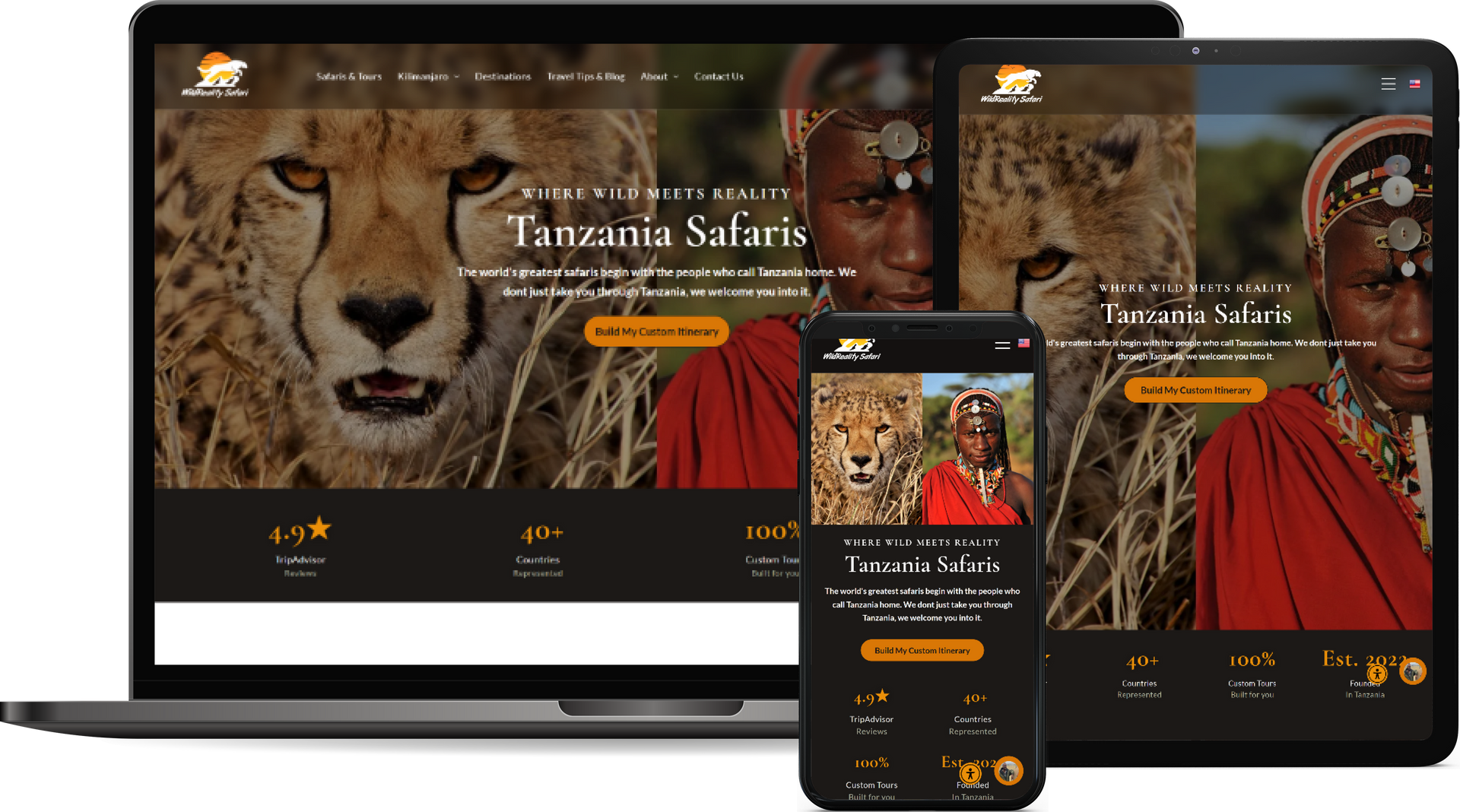
- Redesign the experience for trust and conversion. We rebuilt the front end around proof and clarity: an immersive hero, an at-a-glance trust bar (rating, countries served, local team, founded date), a founder story, real accreditations, a structured and priced tour catalog, destination-based navigation, a guided “Planning Your Safari” journey, and a practical-questions FAQ, all pointed toward a single, repeated call to plan a trip.
The Results
The new structure gives WildReality Safari something the old site never had: discoverability that scales. With a flat, intent-aligned architecture, consolidated authority, and every legacy URL preserved through redirects, the site is now positioned to compete for the route-level and experience-level searches its specialist peers already win. Where the old site ranked for virtually nothing against competitors at Domain Rating 42 to 50, the rebuilt foundation makes topical authority across tours, destinations, Kilimanjaro routes, and practical guidance something the brand can finally build and compound.
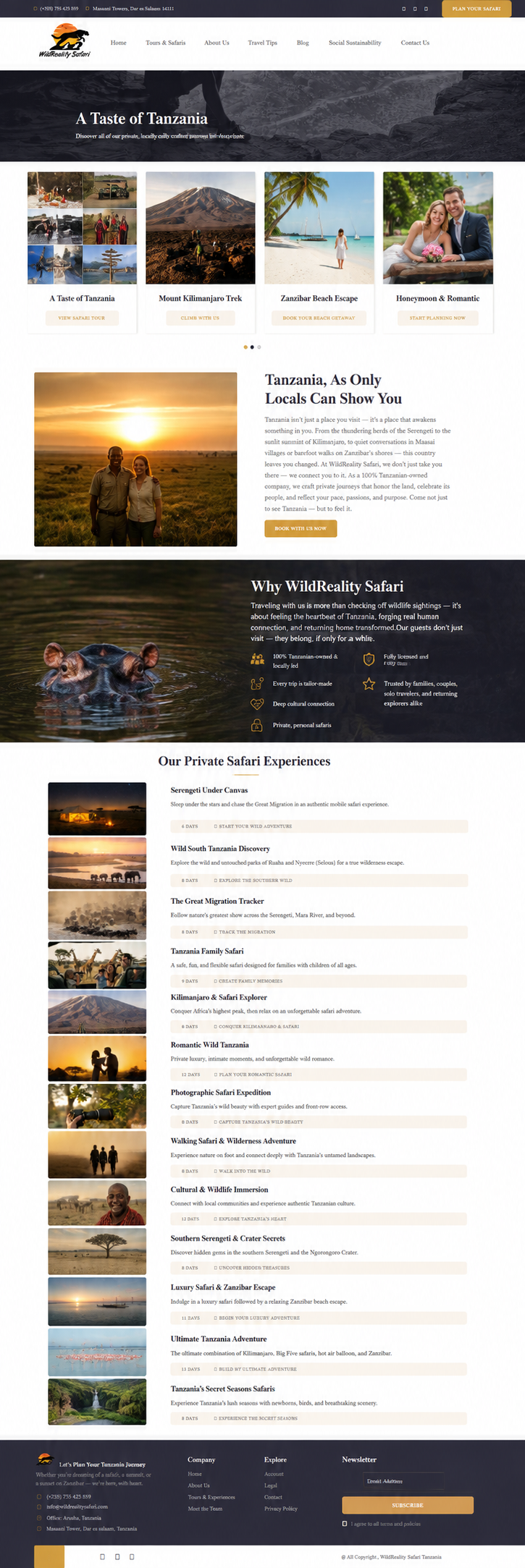
Homepage - Old Design
Homepage - New Design
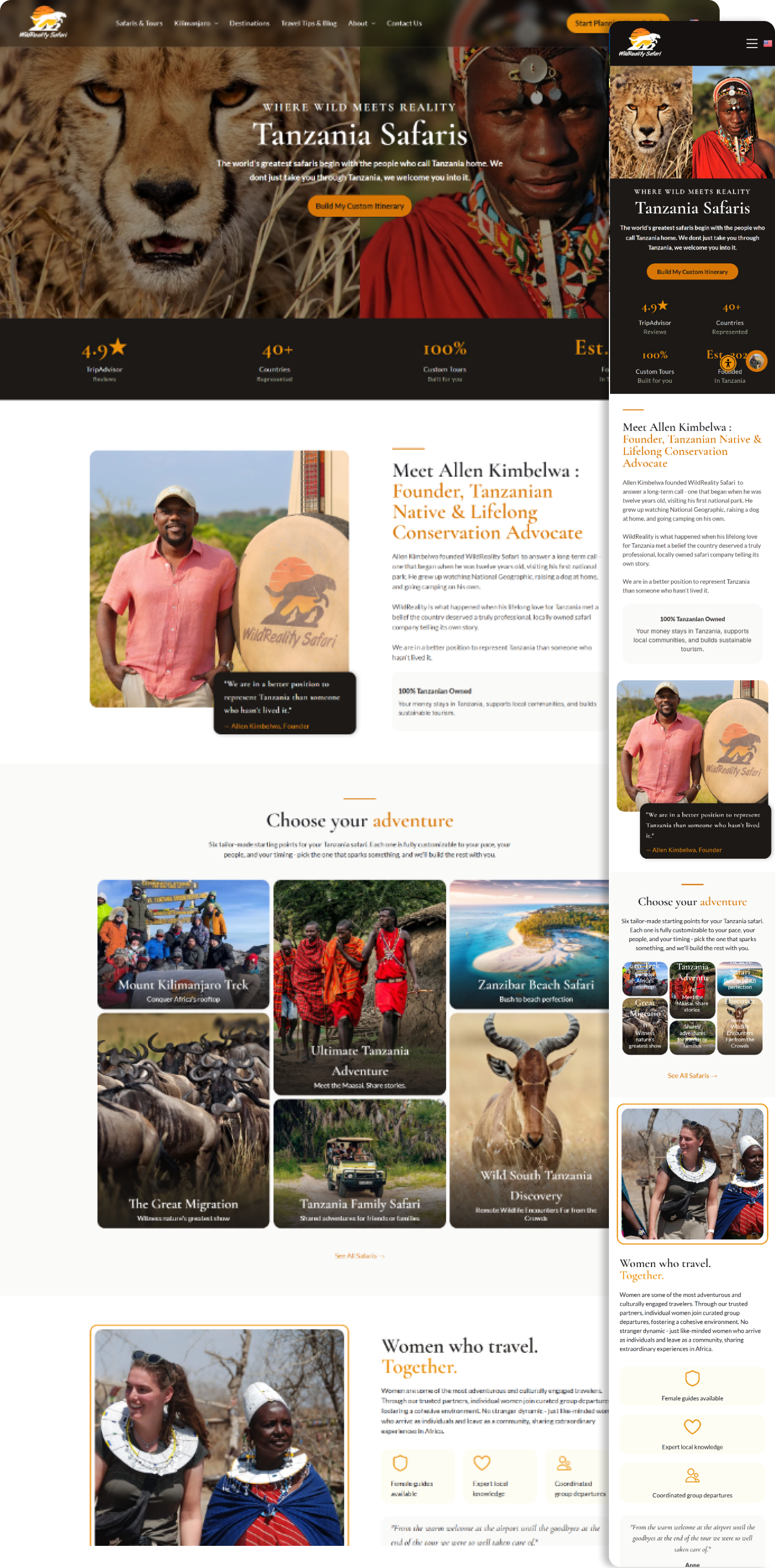
The redesign closes the gap between the brand's reputation and its digital experience. In place of a thin, template-like site with three tour entry points and empty trust signals, visitors now meet an immersive, proof-led experience: the founder's story, real accreditations, community impact, verified reviews, and a structured tour catalog that shows difficulty, duration, and pricing at a glance. Destination-based navigation and a guided planning journey give travelers a reason to explore deeper and stay longer, while a purchase-question FAQ and a persistent inquiry path remove friction on the way to booking. These are the exact conditions that support stronger dwell time and clearer conversion.
Product Page - Old Design
Product Page - New Design
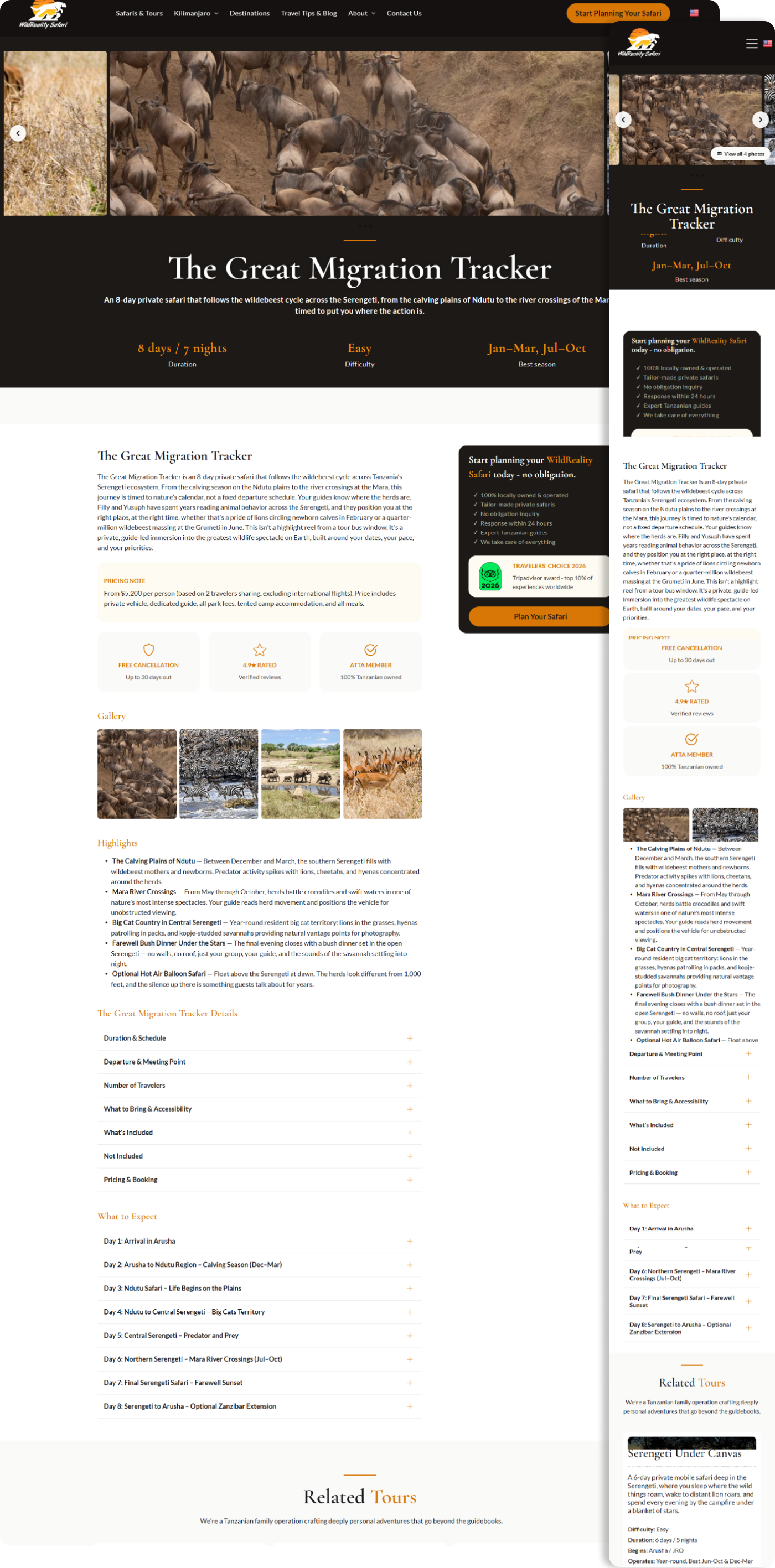
Together, structure, design, and keyword foundation compound into a single growth engine. The clean architecture makes the site discoverable and scalable; the keyword-aligned pages give search engines and travelers a clear match for intent; and the redesigned experience converts that attention into inquiries. For a Tanzanian-owned company with award-winning service and genuine international standing, the new website finally reflects the quality of the business behind it, and gives WildReality Safari a durable platform to grow direct, organic bookings for years to come.
Travel & Tourism Marketing Blog